
Verified Alumni Only
2011 RAND Learning from Experience - Volume IV: Collins Submarine
John Schank et al
RAND
2011
ISBN-13
978-0-8330-5898-0
Shareable Page URL:
Must be logged in to download file.
This is a Volume 4 of a 4 volume collection of submarine acquisition lessons learned prepared by RAND in 2011. One of the authors was Robert (Bob) Murphy (NRHQ 1971 - 2003) headed the NR Fiscal, Acquisition and Logistics Management Division (08H) from 1999 - 2003).
Volume I: Lessons from the Submarine Programs of the United States, United Kingdom, and Australia
Volume II: Lessons from the U.S. Navy's Ohio, Seawolf, and Virginia Submarine Programs
Volume III: Lessons from the United Kingdom's Astute Submarine Program
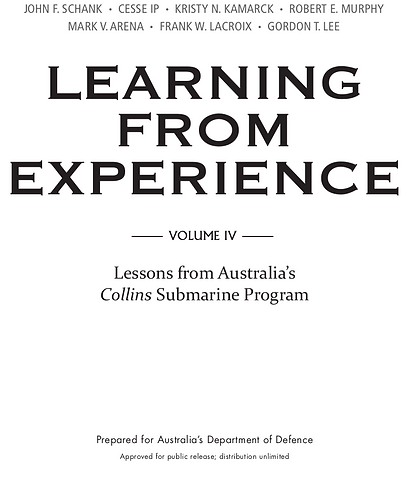
Volume IV: Lessons from Australia's Collins Submarine Program
Large, complex submarine design and construction programs demand personnel with unique skills and capabilities supplemented with practical experiences in their areas of expertise. Recognizing the importance of past experiences for successful program management, the governments of the United States, the United Kingdom, and the Commonwealth of Australia asked the RAND Corporation to develop a set of lessons learned from previous submarine programs that could help inform future program managers.
Vol 1 Summary:
In this volume, the authors present an overview of five submarine programs from the three countries — the U.S. Navy's Ohio, Seawolf, and Virginia programs; the UK's Astute program; and Australia's Collins program — and identify lessons that apply to all of them. The lessons were developed through an extensive literature review and numerous interviews with government and private-sector personnel involved in the programs. Among the most important lessons: Ensure the stability of the program; establish the roles and responsibilities of the government and private-sector organizations; develop knowledgeable and experienced managers; and take a long-term, strategic view of the submarine force and the industrial base.
Schank, John F., Frank W. Lacroix, Robert Murphy, Mark V. Arena, and Gordon T. Lee, Learning from Experience: Volume I: Lessons from the Submarine Programs of the United States, United Kingdom, and Australia. Santa Monica, CA: RAND Corporation, 2011. https://www.rand.org/pubs/monographs/MG1128z1.html. Also available in print form.
Vol 2 Summary:
This volume presents lessons from three submarine programs. The RAND team looked at how the programs were managed, the issues that affected management decisions, and the outcomes of those decisions. All three submarine programs had tenuous beginnings. Each experienced cost overruns and schedule delays in the construction of its first-of-class submarine. The Ohio and Virginia programs made corrections, and both are viewed as generally successful. Seawolf, probably due to the changing threat and budgetary environment, was terminated before changes could be made to correct early missteps. An overarching lesson from the three programs is the importance of program stability. Stability applies in many areas — funding consistency, a long-term build strategy, fixed operational requirements, program management, and an integrated partnership between the Navy and the shipbuilders.
Schank, John F., Cesse Cameron Ip, Frank W. Lacroix, Robert Murphy, Mark V. Arena, Kristy N. Kamarck, and Gordon T. Lee, Learning from Experience: Volume II: Lessons from the U.S. Navy's Ohio, Seawolf, and Virginia Submarine Programs. Santa Monica, CA: RAND Corporation, 2011. https://www.rand.org/pubs/monographs/MG1128z2.html. Also available in print form.
Vol 3 Summary:
This volume presents lessons from the UK Astute class. RAND reviewed the history of UK nuclear submarines, investigated how operational requirements were set for the Astute class; explored the acquisition, contracting, design, and build processes that the Astute program employed; and assessed the plans and activities surrounding integrated logistics support for the Astute. The impact of the substantial time gap between the design and build of the Astute and its predecessor nuclear submarines was greatly underestimated by the private sector and the MOD, and both parties underestimated the impact of the MOD's decision to shift responsibilities to the private sector. Designing and building a submarine requires careful management and oversight and a delegation of roles and responsibilities that recognizes which party — the shipbuilder or the government — is best positioned to manage risks.
Schank, John F., Frank W. Lacroix, Robert Murphy, Cesse Cameron Ip, Mark V. Arena, and Gordon T. Lee, Learning from Experience: Volume III: Lessons from the United Kingdom's Astute Submarine Program. Santa Monica, CA: RAND Corporation, 2011. https://www.rand.org/pubs/monographs/MG1128z3.html. Also available in print form.
Vol 4 Summary:
This volume presents lessons learned from its Collins submarine program that could help inform future program managers. Collins was the first submarine built in Australia. RAND investigated how operational requirements were set for the Collins class; explored the acquisition, contracting, design, and build processes that the program employed; and assessed the plans and activities surrounding integrated logistics support for the class. Although Australia had intended to take an evolutionary approach in procuring the Collins class by using an existing design, no design was suitable, so the program pursued a developmental platform and a developmental combat system. This introduced a high degree of risk into the program, particularly in the combat system technology. Among the important lessons: All appropriate organizations should be involved in a new submarine program from its inception, the majority of the design drawings should be completed before construction begins, and a thorough and adequate testing program should be developed. Because designing and building a submarine is one of the most complex undertakings for a new program, they require careful management and oversight.
Schank, John F., Cesse Cameron Ip, Kristy N. Kamarck, Robert Murphy, Mark V. Arena, Frank W. Lacroix, and Gordon T. Lee, Learning from Experience: Volume IV: Lessons from Australia's Collins Submarine Program. Santa Monica, CA: RAND Corporation, 2011. https://www.rand.org/pubs/monographs/MG1128z4.html. Also available in print form.